Acrel Electrical Comprehensive Management and Energy Consumption Control Solution for the Coating Industry
- Acrel
- Sep 10, 2026
- Asia

Production lines for lithium battery separators, optical films, release films, PCB coating, functional coatings, packaging anticorrosion and other applications are characterized by high-precision and continuous production conditions. These production lines are equipped with a large number of variable frequency drives, servo drives, heating modules, fans, RTO exhaust gas treatment equipment and other devices, which operate under frequent high-frequency start/stop conditions, dynamic speed regulation and instantaneous load fluctuations for long periods. They commonly experience electrical issues such as harmonic interference, frequent motor faults and coarse energy consumption data management, which directly affect coating accuracy, product yield, equipment service life and production costs. In response to the specific operating conditions of the coating industry, Acrel has launched an integrated electrical comprehensive management solution combining ANAPF harmonic mitigation, ARD motor protection, and AC/DC intelligent energy consumption monitoring. From three dimensions—power quality, equipment safety and energy consumption management—the solution enables refined management to support stable production, reduce faults, save electricity and quantify energy consumption data.
I. Core Electrical Issues in Coating Production Lines

Coating production requires stringent power supply stability, equipment reliability and controllable energy consumption. Even minor electrical disturbances can cause product defects and production losses. The industry mainly faces the following three common issues:
1. Excessive harmonics affecting production accuracy and continuity
Variable frequency drives and servo equipment densely deployed on production lines generate harmonics, mainly the 5th, 7th and 11th harmonics, resulting in voltage waveform distortion and unstable power supply. This can easily cause abnormal tension control of coating machines, measurement deviations in thickness gauges and inaccurate temperature control, leading to uneven coating thickness, transverse streaks, web breaks and increased defective roll rates. At the same time, harmonics can cause overheating of cables and equipment, reduce the power factor, trigger power factor penalty charges, and may also cause neutral conductor overload and nuisance tripping of circuit breakers. Interruptions to 24-hour continuous production can result in material waste and production capacity losses.
2. High motor failure rates and significant losses caused by downtime
Unwinding, traction, rewinding, oven fans and other equipment frequently start and stop and are subject to impact loads during long-term operation. Combined with humid and dusty workshop environments, motors are prone to faults such as overload, phase loss, locked rotor and leakage. Traditional thermal overload relays provide limited protection functions and have slow response times, making them unsuitable for continuous production requirements. This can easily lead to motor burnout and unexpected downtime, increasing maintenance costs. In addition, voltage sags and momentary voltage fluctuations in the power grid can cause servo systems to lose synchronization, resulting in web breaks and product scrap.
3. Coarse energy consumption statistics and insufficient data support for energy saving and cost reduction
Most coating companies only monitor the total electricity consumption of the workshop and cannot distinguish the energy consumption proportions of different process sections, such as the main coating machine, oven heating, fans and RTO exhaust gas treatment. As a result, it is difficult to calculate unit product energy consumption, identify high-energy-consumption points and verify the effectiveness of energy-saving improvements. Meanwhile, regenerative energy generated by variable frequency drive braking is mostly dissipated through braking resistors, resulting in energy waste and increased workshop temperature. There is also a lack of professional metering methods to monitor energy losses and recovered energy, leaving energy consumption management without quantitative support.
II. ANAPF Active Power Filter: Improve Power Quality and Stabilize Production Conditions
To address excessive harmonics, voltage fluctuations, equipment misoperation and nuisance tripping in coating workshops, Acrel ANAPF series active power filters adopt a shunt installation method and are suitable for various nonlinear loads such as variable frequency drives and servo equipment in low-voltage distribution systems. They are core equipment for optimizing power quality in production lines.
The equipment can detect harmonic currents in the line in real time and rapidly output reverse compensation currents to correct the voltage and current waveforms of the power grid to standard sinusoidal waveforms. It supports compensation of 2nd–31st harmonics and can be customized for specific harmonic orders as required. The instantaneous response time is ≤100 μs, and the full response time is ≤5 ms, enabling dynamic adaptation to load fluctuations. The harmonic compensation efficiency is ≥95%, and after commissioning, the system THDi can be stably controlled below 5%.

The products are available in three forms: floor-standing cabinet, wall-mounted and drawer-type, respectively suitable for centralized distribution system upgrades for entire plants, harmonic mitigation for individual coating machines, and embedded installation inside switchboards, supporting both new production lines and retrofit projects. Three operating modes are supported: harmonic compensation only, reactive power compensation only, and simultaneous harmonic and reactive power compensation. These functions can effectively improve the system power factor, avoid electricity penalty charges, reduce heat losses in cables and equipment, improve coating non-uniformity, transverse streaks and web breaks, and ensure continuous and stable production line operation.
III. ARD Intelligent Motor Protection: Reduce Equipment Failures and Downtime Frequency
In response to the characteristics of frequent motor start/stop operations, significant load fluctuations and complex operating conditions on coating production lines, Acrel ARD2F/ARD3F series intelligent motor protection devices can replace traditional thermal overload relays and provide comprehensive safety protection for production line power equipment.

The equipment integrates comprehensive protection functions including overload, phase loss, three-phase imbalance, locked rotor, leakage, start-up timeout, anti-voltage-sag and other protections, making it suitable for coating industry operating conditions. The dedicated anti-voltage-sag function can withstand instantaneous voltage drops in the power grid, preventing servo system misalignment and web-break downtime. The leakage protection function can be adapted to solvent production workshops to eliminate electrical safety hazards. It also provides fault data recording and traceability functions, enabling maintenance personnel to quickly identify problems and shorten troubleshooting time.
The products offer strong compatibility and can be rapidly retrofitted to both new and existing equipment. They can be connected to PLCs and upper-level control systems to enable real-time monitoring of equipment operating status and proactive fault warnings, effectively reducing the probability of motor burnout and unexpected downtime and ensuring continuous production line operation.
IV. Hierarchical Energy Consumption Monitoring: Making Energy Consumption Visible, Controllable and Traceable
To address the issues of coarse energy consumption statistics, lack of regenerative energy metering and difficulties in cost accounting in the coating industry, Acrel has established a three-level energy consumption monitoring system consisting of “main incoming line + branch circuits + DC bus”, combined with a cloud-based energy management platform to achieve refined electricity consumption management across the entire process.
1. Overall equipment energy consumption and power quality monitoring
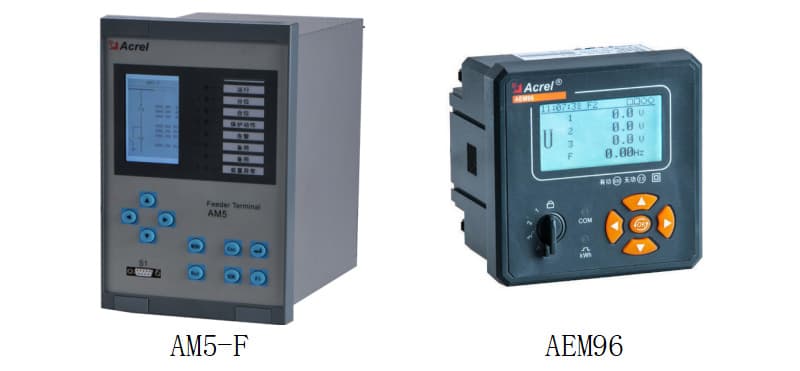
ACR/APM multifunction meters are used to monitor the main incoming line of the coating machine, accurately collecting voltage, current, power, power factor, harmonic distortion rate and various energy parameters. This provides both metering and basic power quality monitoring, supporting overall equipment energy consumption statistics and abnormal electricity consumption analysis.

2. Wireless energy consumption monitoring by branch and application
ADW300 wireless IoT energy meters are used, featuring compact DIN-rail installation and supporting 4G, LoRa, WiFi and other communication methods. They can be flexibly deployed at distributed points such as different temperature zones of ovens, cooling fans and RTO equipment to monitor the energy consumption of individual branch equipment. Combined with peak and off-peak electricity tariffs, they can identify high-energy-consumption processes and provide quantitative support for process optimization, energy-saving improvements and batch cost accounting.

3. Dedicated metering of DC regenerative energy
Based on the DJSF1352-RN bidirectional DC energy meter, the meter is installed on the DC bus side of the variable frequency drive to collect regenerative energy generated during equipment start/stop and braking processes. This fills the gap in DC-side energy consumption monitoring, quantifies regenerative energy losses and energy-saving potential, and provides a data basis for energy-saving improvements.

4. Centralized management through the cloud platform
ANet intelligent gateways are used to aggregate monitoring data from all types of meters. Based on the AcrelCloud-5000 energy management platform, the system enables real-time energy consumption monitoring, year-on-year and month-on-month data analysis, abnormal electricity consumption alarms and automatic report generation, helping enterprises optimize production scheduling, calculate unit consumption and achieve digitalized energy consumption management.


V. Standardized Industry-Based Selection Solutions
According to different production line scales and production requirements in the coating industry, three highly adaptable and directly implementable selection solutions are provided:
1. Small experimental/sample coating machine: equipped with an ACR220EL multifunction meter, ARD2F motor protection device and WHD temperature and humidity controller to meet basic energy consumption metering, motor protection and cabinet anti-moisture/dehumidification requirements, suitable for R&D and sample production scenarios.
2. Lithium battery high-speed wide-web coating production line (mainstream standard configuration): equipped with a wall-mounted ANAPF active power filter, ARD3F motor protection device, ADW300 wireless energy meter and ARCM electrical fire monitoring device to provide power quality management, equipment protection, energy consumption management and hazard warning, ensuring stable operation of high-speed mass production.
3. Entire plant with multiple production lines + RTO exhaust gas treatment workshop: equipped with a floor-standing ANAPF filter cabinet, harmonic monitoring instrument, ACR330ELH high-precision energy meter and cloud-based energy management system to achieve plant-wide power quality optimization, centralized energy consumption management and unified equipment operation and maintenance, suitable for refined management of large-scale factories.
VI. Solution Extensions: Enabling Multiple Application Scenarios
In addition to the coating industry, this AC/DC metering and power monitoring solution can also be applied to two general industrial scenarios. The first is elevator kinetic energy recovery, where bidirectional AC/DC energy meters are used to monitor equipment electricity consumption and recovered energy, quantify energy-saving benefits and meet project acceptance specifications. The second is aging tests of UPS systems, EV chargers and energy storage equipment using dummy loads. Through high-frequency data acquisition, data storage and automatic report generation, the solution replaces manual recording, improves testing accuracy and efficiency, and meets equipment quality inspection and acceptance standards.
VII. Solution Summary and Value
The high-precision and continuous production characteristics of the coating industry impose stringent requirements on power supply stability, equipment safety and energy consumption transparency. Acrel’s electrical comprehensive management solution addresses these requirements by mitigating harmonics through active power filtering and optimizing the power supply environment, thereby reducing product defects and production downtime losses; by reducing equipment failure probability and maintenance costs through intelligent motor protection; and by implementing hierarchical energy metering and a cloud-based platform to achieve energy consumption traceability, quantified energy savings and controllable costs.
The complete solution offers strong compatibility and low retrofit difficulty, and can be applied to both equipment OEM integration and on-site retrofit scenarios. It effectively addresses the three core issues of power quality risks, equipment operating risks and coarse energy consumption management in the coating industry, helping enterprises improve production quality, stabilize equipment operation, reduce electricity consumption and achieve digitalized management. It provides reliable electrical technology support for intelligent manufacturing and green energy-saving upgrades in new energy, electronics, packaging and other related coating fields.