Acrel’s Secondary Solution Handles Everything from High Voltage to DC
- Acrel
- Aug 03, 2026
- Products


Under the "Dual Carbon" goals, the combination of photovoltaic power and alkaline water electrolysis for hydrogen production has become a core pathway for integrating renewable energy and achieving deep decarbonization in industry. The intermittent nature of wind and solar power generation, high-power rectification harmonics, the flammable and explosive nature of hydrogen, and the risk of high-current DC leakage are the four major challenges in the electrical design of hydrogen production stations.
Acrel, leveraging the mainstream ALK alkaline electrolysis process, has developed a comprehensive secondary solution covering 10 kV high voltage, 24-pulse rectification, 0.4 kV auxiliary equipment, DC safety monitoring, and energy management. This solution addresses the full-chain electrical challenges of photovoltaic self-generation and self-consumption green hydrogen stations from four key dimensions: protection, metering, explosion protection, and dispatch.

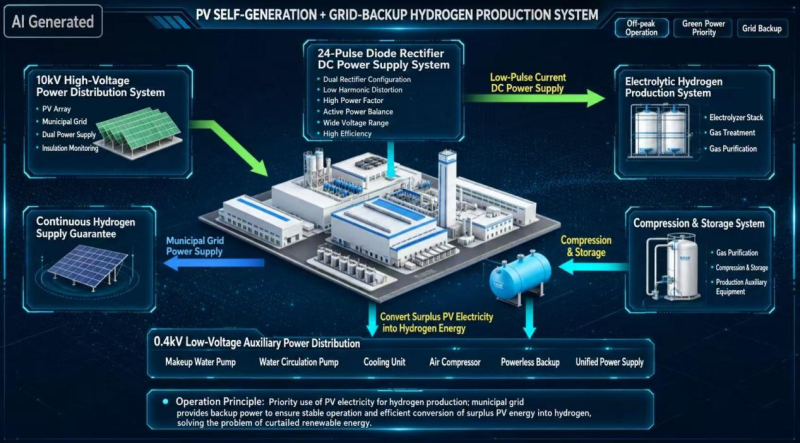
The complete photovoltaic self-generation and self-consumption + grid-backup hydrogen production system consists of four core units:
10 kV high-voltage power distribution system:
PV step-up transformer + dual power sources from the municipal grid, ensuring continuous hydrogen production during periods of insufficient sunlight;
24-Pulse Phase-Shift Rectifier DC System:
Utilizes dual phase-shift transformers to rectify AC power into the low-voltage, high-current DC required by the electrolyzer; high- and low-voltage reactive power compensation suppresses harmonics and reduces DC ripple;
Electrolytic Hydrogen Production Process System: The main hydrogen production line comprising the electrolyzer, gas-liquid separation, hydrogen purification, compression, and storage;
0.4 kV Low-Voltage Auxiliary Equipment Power Distribution:
Unified power supply for auxiliary loads such as makeup water pumps, cooling units, air compressors, and reactive power compensation.
Operating Logic: Prioritizes hydrogen production using green solar power, with the utility grid providing backup power when necessary. This effectively converts surplus wind and solar energy into hydrogen, addresses the challenge of integrating and consuming renewable energy into the grid, and enables zero-carbon hydrogen production throughout the entire process.
2. 10 kV High-Voltage Secondary Protection: Dedicated Protection for Rectifier Transformers
In accordance with the NB/T10447-2020 standard, a five-level protection system has been established for 24-pulse dual-phase-shift rectifier transformers and photovoltaic dual-power-source operating conditions. Each of the two rectifier transformers is independently equipped with a complete set of protections to eliminate the risks of short circuits, turn-to-turn short circuits, and harmonic overloads.
Overview of Core Equipment Configuration

3. Secondary Equipment for Grid-Connected Photovoltaic Systems: Compliance with Anti-Reverse-Flow and Anti-Islanding Requirements
For distributed PV systems operating at 10 kV with self-generation for self-consumption (excess power not fed into the grid), grid connection safety is a mandatory requirement for project commissioning. The complete system configuration mitigates the two major grid compliance risks: islanding and reverse power flow.
Overview of Core Equipment Configuration

4. 0.4 kV Low-Voltage Auxiliary Equipment Measurement and Control: Dedicated Protection for Hydrogen Production Pumps and Compressors
Motors used for alkali replenishment, cooling, and air compression at hydrogen production stations operate continuously 24 hours a day. The humid environment and alkaline mist can easily cause motor lockups, electrical leakage, and three-phase imbalance; therefore, low-voltage secondary equipment is specifically designed to withstand explosive industrial conditions.
Overview of Core Equipment Configuration

5. Three Essential Safety Devices to Ensure a Solid Foundation for Explosion-Proof Hydrogen Production
1) DC Insulation Monitor AIM-D100-TH

Electrolyzers operate at low-voltage, high-current DC levels, and the electrolyte is conductive; alkali leaks and moisture can easily cause ground faults, and even a tiny electric spark can trigger a hydrogen explosion. The system continuously monitors the insulation of the DC 100–1000 V busbar and immediately triggers an alarm and shuts down the system in the event of insulation failure. It is a mandatory safety feature in hydrogen production facilities.
2) Full Line of AC and DC Meters

3) BM200/BM100 Intrinsically Safe Isolation Barrier

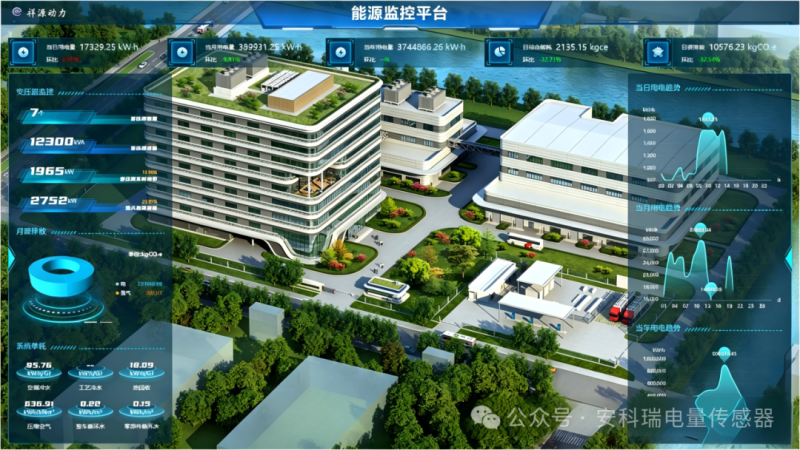
6.Acrel-2000MG Hydrogen Production Station Energy Management System: The Intelligent Control Center for the Entire Station
Hardware devices provide protection and monitoring, while the energy management system performs integrated optimization and dispatch of generation, transmission, consumption, and storage—together, they form the core digital platform for photovoltaic green hydrogen stations.

Core System Value
Multi-source Coordinated Dispatching:
Integrates solar power, grid power, electrolyzers, and energy storage; operates at full capacity for hydrogen production during periods of high solar generation; uses grid power as a backup during nighttime or overcast periods; and maximizes the utilization of green electricity;
Comprehensive Data Monitoring:
Aggregates data from 10 kV high-voltage systems, 0.4 kV auxiliary equipment, DC electrolysis circuits, ambient temperature and humidity, and hydrogen equipment operations to generate reports on power generation, hydrogen production energy consumption, and O&M;
Tiered Fault Alerts:
Pop-up alerts with audible and visual warnings for anomalies such as overcurrent, insulation degradation, arcing, islanding, and motor overload; triggers automatic circuit breaker tripping to mitigate the risk of incident escalation;
Peak-Shaving and Valley-Filling to Reduce Costs:
By leveraging peak-valley electricity pricing strategies—increasing hydrogen production during off-peak hours and reducing grid power purchases during peak hours—the system significantly lowers the facility’s operational electricity costs;
Remote O&M Integration: Supports both local large-screen displays and cloud-based remote access, meeting the visual management needs of owners, the power grid, and O&M providers.
7. Solution Summary: Suitable for PV-based alkaline hydrogen production projects of all scales
Currently, ALK alkaline electrolysis accounts for over 80% of the market share. This secondary equipment solution covers everything from small-scale distributed photovoltaic hydrogen production stations to large-scale, 10,000-metric-ton-class green hydrogen bases integrating wind and solar power, addressing several key pain points in the industry:
- 24-pulse rectification with harmonic mitigation and tiered reactive power compensation for high and low voltages, ensuring compliance with grid power quality acceptance standards;
- Triple safety protection—three-phase differential protection on all sides of the rectifier transformer, DC insulation, and explosion-proof safety barriers—to accommodate hazardous hydrogen operating conditions;
- Comprehensive solutions for PV anti-islanding and anti-backflow protection, ensuring grid-connection compliance without penalty risks;
- Full AC/DC energy metering for accurate calculation of the cost per kilowatt-hour of green hydrogen;
- Integrated energy management platform to optimize renewable energy consumption and reduce costs while improving efficiency.
Amid the wave of new power system development, photovoltaic water electrolysis for hydrogen production is a key driver for long-duration energy storage and industrial decarbonization. A robust and reliable secondary electrical system serves as the foundational guarantee for the safe, stable, and economical operation of green hydrogen projects. Acrel provides a one-stop, comprehensive solution ranging from microprocessor-based protection devices, metering instruments, and isolation safety barriers to energy management platforms, supporting the large-scale implementation of the green hydrogen industry.